Sainte-Mere-Eglise, Normandy
Sainte-Mere-Eglise, Normandy was photographed between 2014 and 2024 on multiple return trips by James Derheim, European Focus Private Tours.
Ancient village where the D-day landings took place by air. (More images to be added)
Founded in the eleventh century, the earliest records (1080–1082) include the Latin name Sancte Marie Ecclesia, meaning “Church of St. Mary”, while a later document written in the local language, Norman, in 1317 mentions Saincte Mariglise. The current French form of the name means “Holy Mother Church”.
The town was involved in the Hundred Years’ War and the Wars of Religion.
D-Day battle
The town played a significant part in the World War II Normandy landings because of its position in the middle of route N13, which the Germans would have used to counterattack Allied landings on Utah and Omaha Beaches. In the early morning of 6 June 1944, mixed units of the U.S. 82nd Airborne and U.S. 101st Airborne Divisions occupied the town in Mission Boston, making it one of the first towns liberated in the invasion.
The early airborne landings, at about 1:40 a.m., resulted in heavy casualties. Some buildings in town caught fire that night, illuminating the sky, and making easy targets of the descending men. Some were killed by the fire. Many hanging from trees and utility poles were shot.
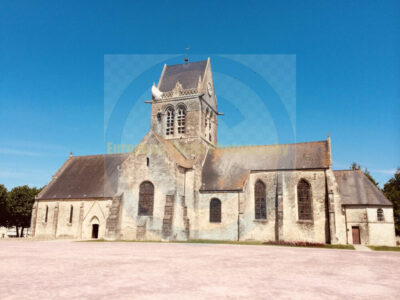
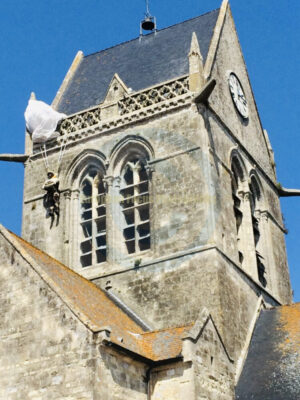
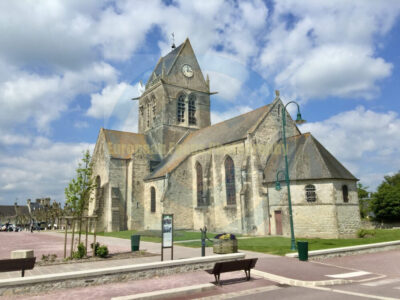
A well-known incident involved paratrooper John Steele of the 505th Parachute Infantry Regiment (PIR), whose parachute got caught on the tower roof and spire of the town church. He hung there for two hours, pretending to be dead until the Germans took him prisoner. Steele later escaped and rejoined his division when U.S. troops of the 3rd Battalion, 505th Parachute Infantry Regiment attacked the village, capturing 30 Germans and killing 11. The incident was portrayed in the movie The Longest Day by actor Red Buttons. (Wikipedia)