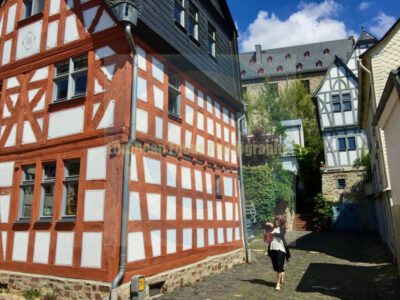
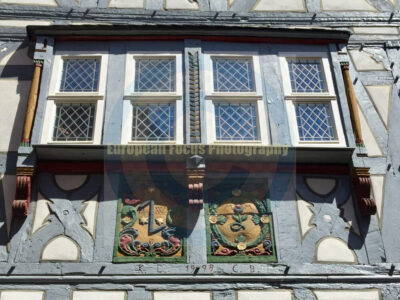
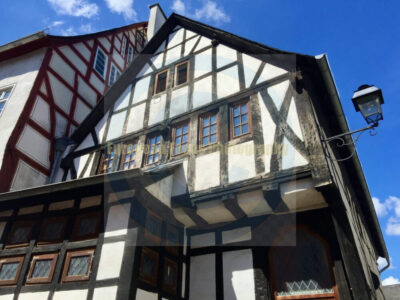
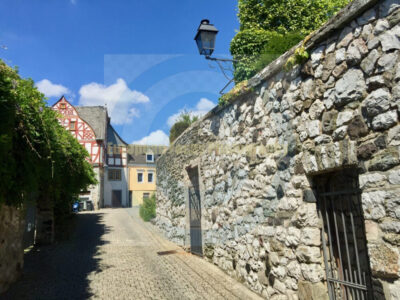
Limburg an der Lahn, Hessen
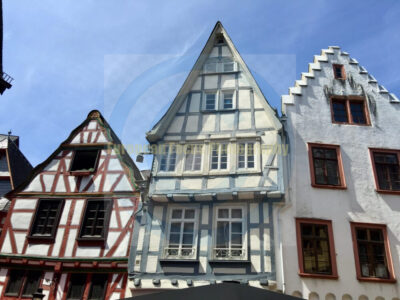
Limburg, Germany was photographed on a genealogy tour with a client in July, 2015 by James Derheim, owner of European Focus Private Tours
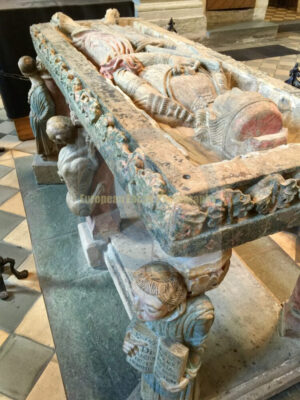
- Konrad Kurzbold: The founder of the original church, his tomb with a 13th-century effigy on 11th-century supports is in the north transept.
- Bishops: The first bishops of the Diocese of Limburg (established 1827) are buried in the nave, while later bishops are in the crypt chapel.
-
History
When the first church was built above the Lahn on the Limburger Felsen (“Limburg Rock”) is not exactly known. According to a reference in the Nekrolog of the Basilica of St. Castor in Koblenz, Archbishop Hetti of Trier (814–847) consecrated a church of Saint George in “Lympurgensis”.
Incidental archaeological discoveries from Carolingian times under the current church support the existence of a 9th-century church building in the area of the present chapel. There are no actual remains of the building, however, nor any indications of its exact location or of its patron saint. Since the aforementioned record of its consecration was first written down in the 16th century, its accuracy has been controversial in scholarly literature.
On 10 February 910, King Louis the Child issued a deed for the foundation of a Stift of canons, which the Gaugraf of Niederlahngau, Konrad Kurzbold (~ 885–948) had pushed for. The construction of a collegiate church probably began immediately. The choice of Saint George as patron is mentioned by Emperor Otto I in a document from the year 940. By then, the first church had very likely already been completed.
In the 11th century, that first church was replaced by an Early Romanesque basilica. A lead reliquary from the 11th century, found in 1776 in the main altar in the form of a schematic model of a church, mentions a Graf (count) Heinrich as founder and builder of a new “templum“, that being apparently the new basilica.
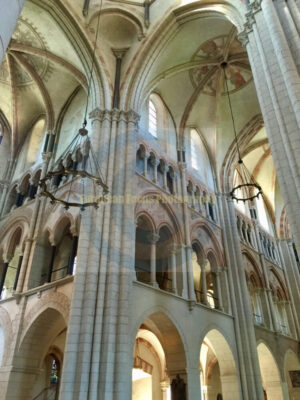
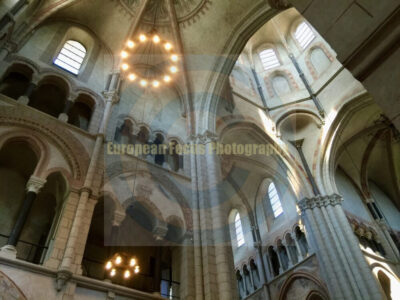
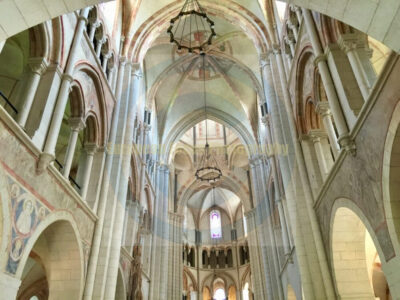
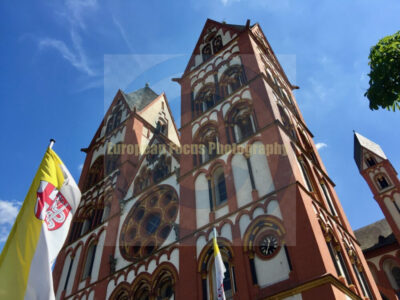
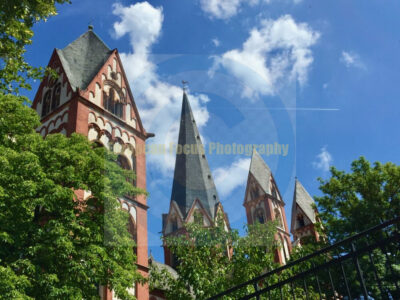
In about 1180 an extensive remodelling was started that gave the church its present-day shape. In the western part, the nave and the transept, and the walls up to the top of the level of the galleries, are remainders of the Early Romanesque basilica. The Gothic modernization was begun in the west and proceeded eastward. Most of the windows and the western portal were enlarged in Gothic style, but the vaults of the aisles of the nave are still of Romanesque type. Relics of the Romanesque walls of the choir, including a bank of stone, can be seen below the arcades around the choir. The outer walls of the ambulatory are originally Gothic, and so are the vaults of the ambulatory. Many details inside the church suggest that the builders followed the example of Laon Cathedral, the construction of which had been started one or two decades before the Gothic reworking of the collegiate church in Limburg.
In 1802, during secularisation, the Stift’s independence was brought to an end (like many other abbeys and Stifte) and it was given to the Princes of Nassau-Usingen. This seizure took place as part of the German mediatization, in which the House of Nassau received the Stift as compensation for the loss of the County of Saarbrücken on the left bank of the Rhine. After secularisation, the church was used as a parish church. In 1827, at the request of the Duchy of Nassau, the independent Diocese of Limburg was founded. This diocese contained the territory of the Duchy and the free city of Frankfurt am Main, with the bishop’s seat in the former collegiate church of St George, which was promoted to the rank of cathedral.
The first bishop of Limburg was Jakob Brand (1827–1833). The diocese has currently about 700,000 Catholics and is one of the younger dioceses. On 2 February 2007, Pope Benedict XVI accepted the age-related resignation of former bishop Franz Kamphaus. Franz-Peter Tebartz-van Elst was named new bishop on 28 November 2007, and took office on 20 January 2008. He was suspended on 23 October 2013, he was thereupon general vicar Wolfgang Rösch, who in turn was replaced by Georg Bätzing, who was elected to the office of Bishop by the Cathedral Chapter, confirmed by Pope Francis and ordained by Archbishop Woelki in 2016, since 2020 he has been Chairman of the German Bishops‘ Conference.
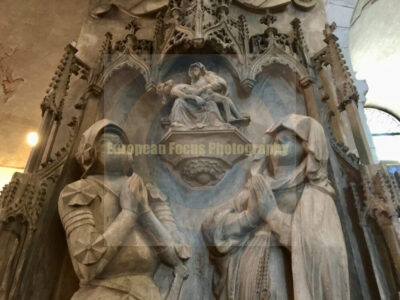
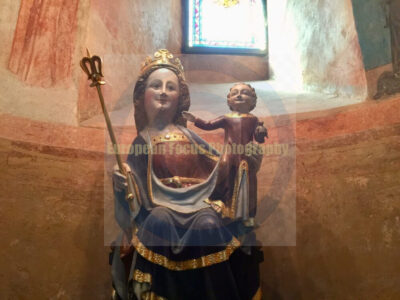
- Limburg Cathedral (Dom zu Limburg) features notable depictions of the Virgin Mary and Child, including the famous “Limburg Madonna,” a crowned, late 13th-century statue found near the old monastery, depicting Mary holding the blessing Christ Child and an apple (symbolizing the New Eve). Another significant image is a sandstone statue in the town church (Limburg Stadtkirche), representing Mary as a symbolic throne for Christ. These statues, along with other medieval sculptures, highlight Mary’s role as “Throne of Wisdom” (Sedes Sapientiae). Wikipedia