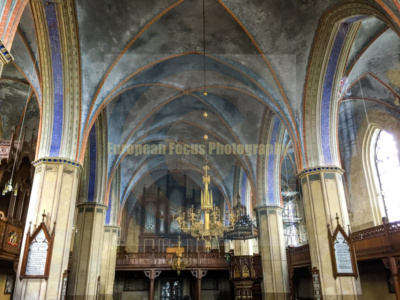
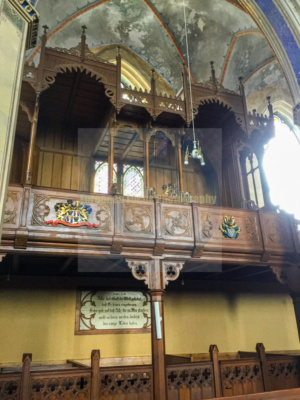
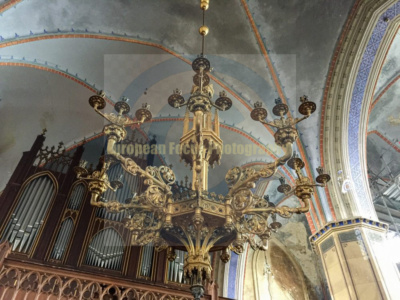
Stralsund, Mecklenburg-Vorpommern
Stralsund, Germany was photographed by James Derheim, European Focus Private Tours, in June, 2017
Stralsund officially the Hanseatic City of Stralsund (German: Hansestadt Stralsund), is the fifth-largest city in the northeastern German state of Mecklenburg-Western Pomerania after Rostock, Schwerin, Neubrandenburg and Greifswald, and the second-largest city in the Pomeranian part of the state. It is located on the southern coast of the Strelasund, a sound of the Baltic Sea separating the island of Rügen from the Pomeranian mainland.
The Strelasund Crossing with its two bridges and several ferry services connects Stralsund with Rügen, the largest island of Germany and Pomerania.[4] The Western Pomeranian city is the seat of the Vorpommern-Rügen district and, together with Greifswald, Stralsund forms one of four high-level urban centres of the region.
Stralsund was granted city rights in 1234 and is thus the oldest city in Pomerania. It was one of the most prosperous members of the medieval Hanseatic League. In 1628, during the Thirty Years’ War, the city came under Swedish rule and remained so until the upheavals of the Napoleonic Wars. It was the capital of Swedish Pomerania (New Western Pomerania) from 1720 to 1815. From 1815 to 1945, Stralsund was part of Prussia.
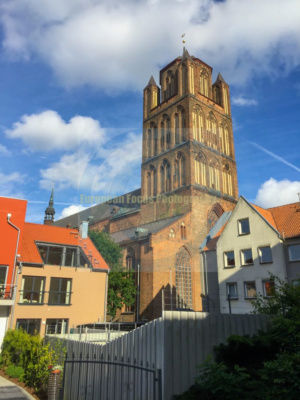
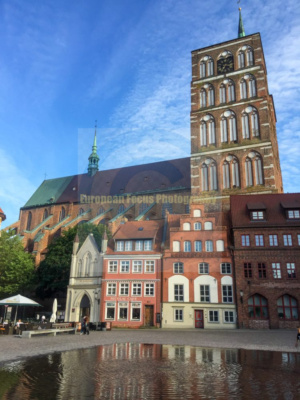
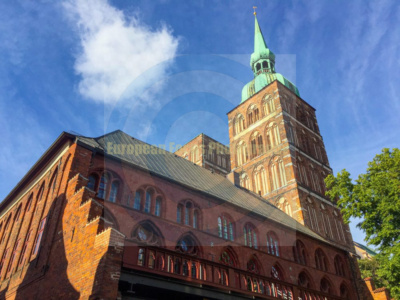
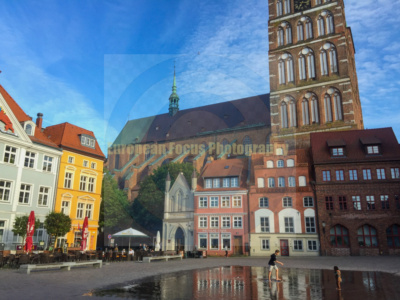
Stralsund’s old town is part of the UNESCO World Heritage Site “Historic Centres of Stralsund and Wismar” alongside the old town of Wismar in Mecklenburg because of its outstanding Brick Gothic buildings and its importance during the time of the Hanseatic League and when the city belonged to Sweden.[5] St Mary’s Church has been the tallest church in the world from 1549 to 1569 and from 1573 to 1647. The city’s other two large churches are St Nicholas’ and St James’. Stralsund is the seat of the German Oceanographic Museum (Deutsches Meeresmuseum) with its satellites Ozeaneum (in Stralsund), Nautineum (on Dänholm Island), and Natureum (on the Fischland-Darß-Zingst Peninsula).
The main industries of Stralsund are shipbuilding, fishing, mechanical engineering, and, to an increasing degree, tourism, life sciences, services and high tech industries, especially information technology and biotechnology.
In the Middle Ages the Stralsund area formed part of the West Slavic Principality of Rügen. The village had a ferry to the island of Rügen. In 1168, following the siege of Arkona, the Principality of Rügen became part of Kingdom of Denmark.
In the course of German Ostsiedlung, many German settlers, gentry and merchants were invited to settle in the principality, and they eventually populated the Strale settlement. Merchants from other countries as well as locals were attracted to the area and made up one third of the settlement’s population. The Danish navy used the isle as well. When the settlement had grown to town size, prince Wizlaw I of Rügen granted Lübeck law to “our town Stralow” in 1234, although a significant settlement had existed long before the formal founding. In 1240, when the prince gave additional land to the town, he called it Stralesund.
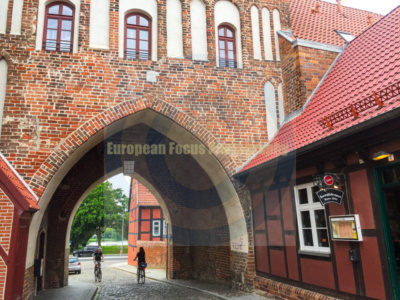
The success of the settlement challenged the powerful Free City of Lübeck, which burnt Stralsund down in 1249. Afterwards the town was rebuilt with a massive town wall having 11 town gates and 30 watchtowers. The Neustadt, a town-like suburb, had merged with Stralsund by 1361. Schadegard, a nearby twin city to Stralsund also founded by Wizlaw I, though not granted German law, served as the principal stronghold and enclosed a fort. It was given up and torn down by 1269 under pressure from the Stralsund Bürger.
In 1293 Stralsund became a member of the Hanseatic League. A total of 300 ships flying the flag of Stralsund cruised the Baltic Sea in the 14th century. In 1325 the Principality of Rügen became part of the Duchy of Pomerania, Stralsund however maintained considerable independence.
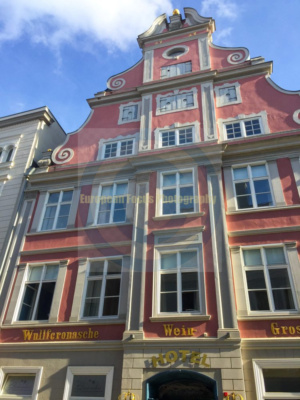
In the 17th century opposing forces in the Thirty Years’ War fought over Stralsund. In the Battle of Stralsund (1628), the Imperial (Catholic) forces commanded by Albrecht von Wallenstein besieged the city after the council refused to accept the Capitulation of Franzburg of November 1627. Stralsund resisted with Danish and Swedish support. The Swedish garrison in Stralsund was the first on German soil in history. With the Treaty of Stettin (1630), the city became one of two major Swedish forts in the Duchy of Pomerania, alongside Stettin (now Szczecin, Poland).
After the war, the Peace of Westphalia (1648) and the Treaty of Stettin (1653) made Stralsund part of Swedish Pomerania. Lost to Brandenburg in the Battle of Stralsund (1678), it reverted to Sweden in the Treaty of Saint-Germain-en-Laye (1679). In the Great Northern War in 1715 Charles XII led the defence of Stralsund for a year against the united European armies. Stralsund remained under Swedish control until the Battle of Stralsund (1807), when Napoleon Bonaparte’s army occupied it. Seized by Ferdinand von Schill’s freikorps in 1809, it subsequently reverted to French control, with Schill killed in action. With the Congress of Vienna (1815), Stralsund became a part of the Prussian Province of Pomerania and the seat of a government region resembling the former Swedish Pomerania.
Following the First World War Stralsund suffered the same sort of political unrest and unemployment that afflicted much of Germany. In May 1919 Stralsund workers clashed with police, and martial law was declared. In the early 1920s the Independent Social Democratic Party (USPD) became the strongest party in Stralsund, but its political fortunes waned rapidly, and in September 1922 it reunited with the Social Democratic Party (SPD). The Stralsunder Zeitung was published as a local newspaper in Stralsund. (Wikipedia)