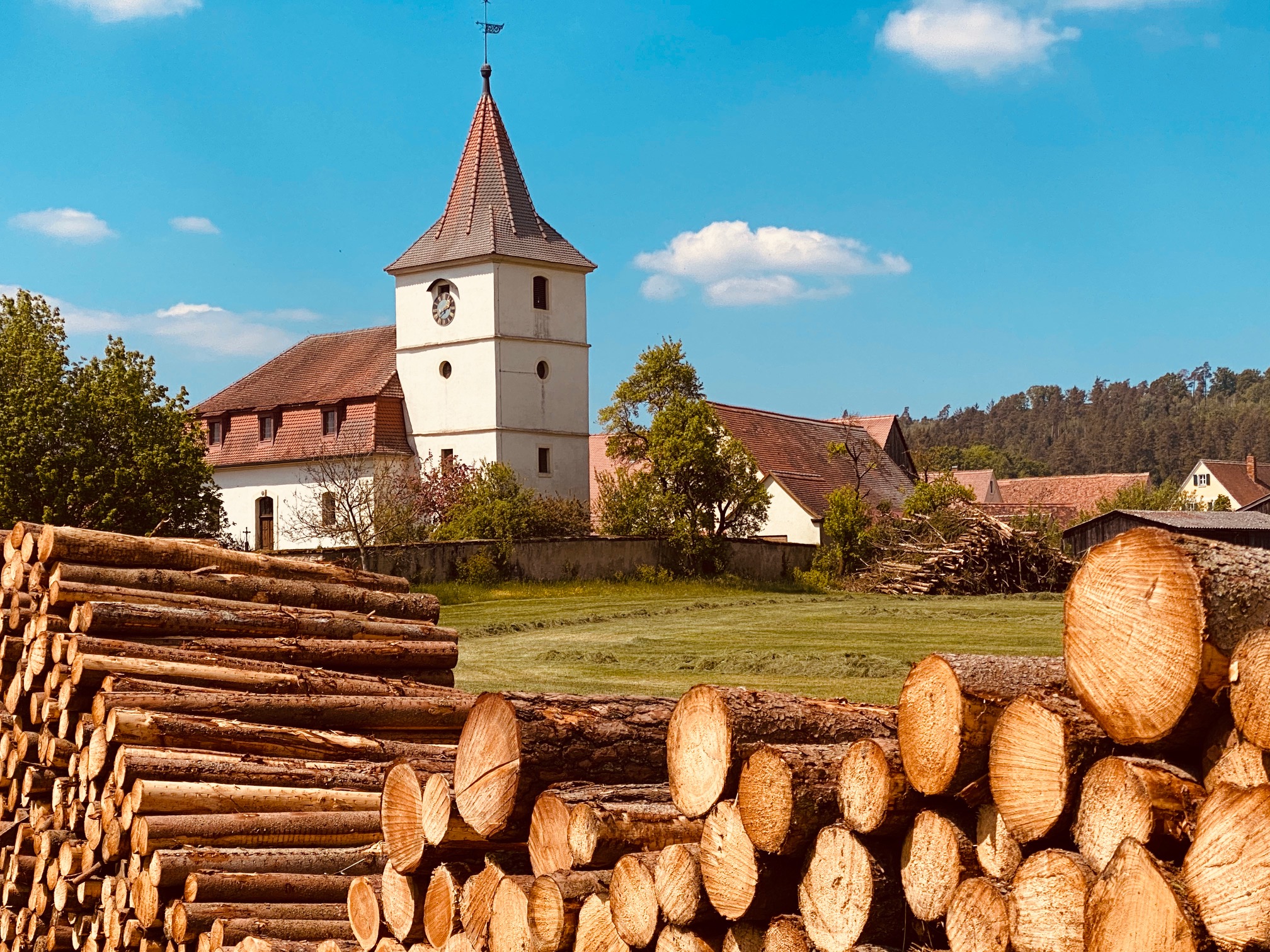
Essweiler, Rheinland-Pfalz
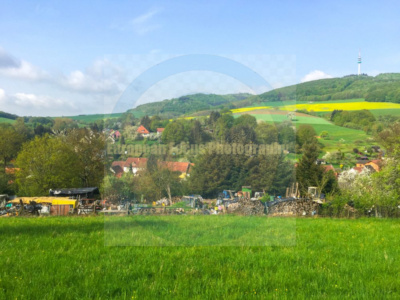
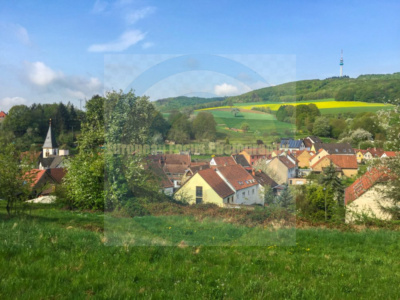
Esseiler, Germany was photographed by James Derheim, European Focus Private Tours, in April and July of 2018 as part of a custom-designed family heritage tour for clients who had ancestors from this village as well as in Italy.
Subject of a report on NBC News featuring European Focus founder and lead guide, James Derheim, reported by Kevin Tibbles https://www.europeanfocus.com/nbc-nightly-news-story-about-european-focus-private-tours/
Famous people
Sons and daughters of the town
- Michael Gilcher (1822–1899), wandering minstrel
- Rudolph Schmitt (1900–1993), clarinettist
Famous people associated with the municipality
- Hubertus Kilian (1827–1899), wandering minstrel, born in Jettenbach, died in Eßweiler
- Alexander Ulrich (1971–), Member of the Bundestag, grew up in Eßweiler.
Buildings
The following are listed buildings or sites in Rhineland-Palatinate’s Directory of Cultural Monuments:[43]
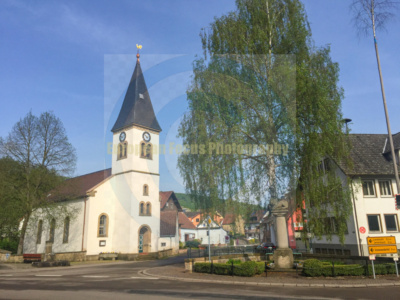
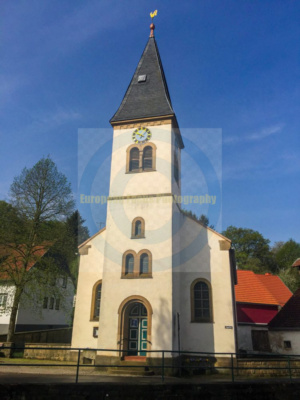
- Protestant church, Läppchen 1 – Baroque aisleless church, 1733, tower with tent roof, 1865, architect Johann Schmeisser, Kusel; organ by E.F. Walcker & Cie. Ludwigsburg from 1869; stone fountain, 1857
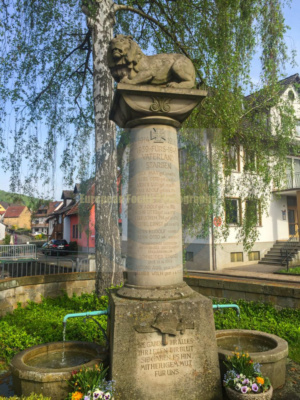
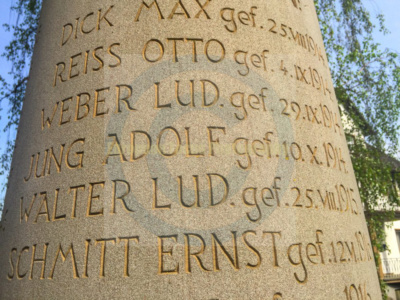
- Near Läppchen 1 – warriors’ memorial 1914-1918 and 1939–1945, fountain complex, 1927, by Karl Dick, Kaiserslautern, expanded after 1945
- Mühlgasse 5 – former gristmill; one-floor sandstone-framed plastered building on raised basement, 1870; technical equipment from 1920s/1930s, turbine from 1950s
- Former workers’ colony of the Schneeweiderhof, west of the village on the Hermannsberg (monumental zone) – dwelling blocks for the quarry workers, two- and three-floor Swiss chalet style buildings of basalt quarrystone, round the back a farm and goat pens, 1922–1924, architects Heinrich Marrat and Eduard Scheler, Cologne
From 1758 to 1763, Johann Julius Printz was the pastor in Eßweiler, and from 1810 to 1817 it was Johann Heinrich Bauer. The Catholics’ share of the population was quite small in Eßweiler. In 1836 and 1837, Eßweiler had 614 inhabitants, of whom 28 were Catholic, 525 were Protestant and 61 were Jewish. As early as 1821, the Eßweiler parish church became a branch of Bosenbach. One of the best known pastors was Christian Böhmer (1823-1877). Born in Kusel, he came to Bosenbach in 1872 and earned himself some measure of fame through his literary endeavours. The Catholics were at this time tended by Wolfstein, while the few Catholics in the Eßweiler Tal before then belonged to Lauterecken, where there was a simultaneous church as early as 1725.[34]
The Jewish community

Important in Eßweiler at one time was the rather great share of the population represented by Jews. Jewish families are known to have lived in Eßweiler in 1680, 1698, 1746, 1776 and 1780. In 1688, there were four Jewish families living in Eßweiler. Their numbers grew steadily over the years until in the 1860s, Eßweiler had one of the biggest Jewish communities in the Kusel district. In 1789, a synagogue in the village was mentioned. The synagogue, locally known as the Judenschule, stood on the Judengasse (“Jews’ Lane”); the building is still standing. In 1867, the Jewish population numbered 85.[25] The number fell steadily over the years that followed as many inhabitants moved to the cities. On 24 January 1906, the Eßweiler Jewish worship community was dissolved. The remaining Jewish inhabitants, the two families of Isidor and his brother Sigmund (or Siegmund) Rothschild, joined the Kusel worship community.[35]
On Kristallnacht (9–10 November 1938), Brownshirts from Altenglan and Theisbergstegen, reinforced by a few NSDAP followers from Jettenbach and Brownshirts from Kusel who happened to be going about in the district destroying Jewish property, thronged into these two men’s houses and laid them waste.[35] Shortly thereafter, the village’s three remaining Jewish residents, the widower Isidor Rothschild, his brother Sigmund and Sigmund’s wife Blondine were taken away to the camps.[15] The last two named are believed to have died at Theresienstadt.[36] Two of their four daughters, too, were murdered in the camps.[37] The other two, and also Isidor’s son, survived the Holocaust and later lived in the United States.
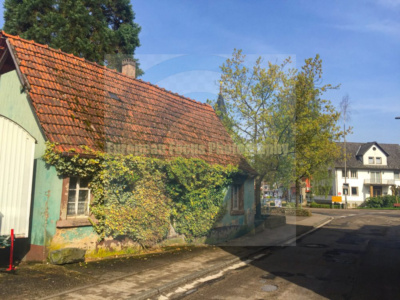
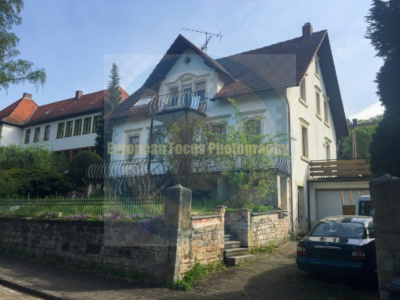
There was a synagogue in the village, known popularly as the Judenschule. It was mentioned as early as 1789.[38] The street on which it stood is to this day popularly known as the Judengasse (“Jews’ Lane”). The synagogue was let out as a dwelling in 1902 and then auctioned in 1907.[39] The building is still standing, but it is now a house, and bears no sign of its original function. In the neighbouring building, renovation work in the 1960s unearthed the remains of a mikveh.
Jewish family names represented in the village were, among others, Rothschild, Loeb, Hermann, Wolf, Dreifuß, Lazarus, Herz and Ehrlich.
The Jews had their own graveyard in Hinzweiler, which was transferred to the Eßweiler community’s ownership in 1904, but later, they also buried their dead in Kaiserslautern.[39][40]
Source: Wikipedia