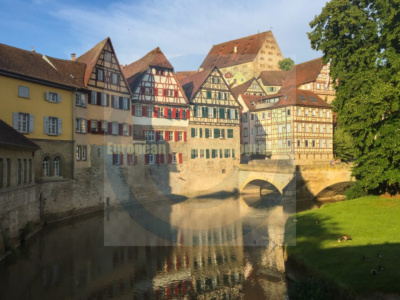
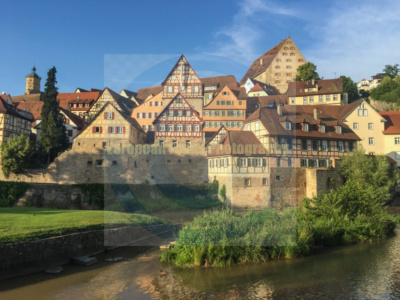
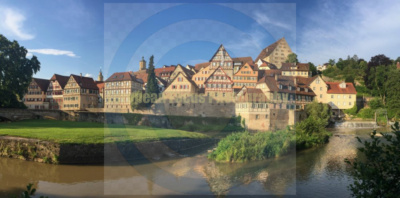
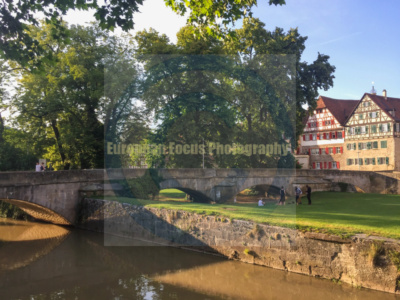
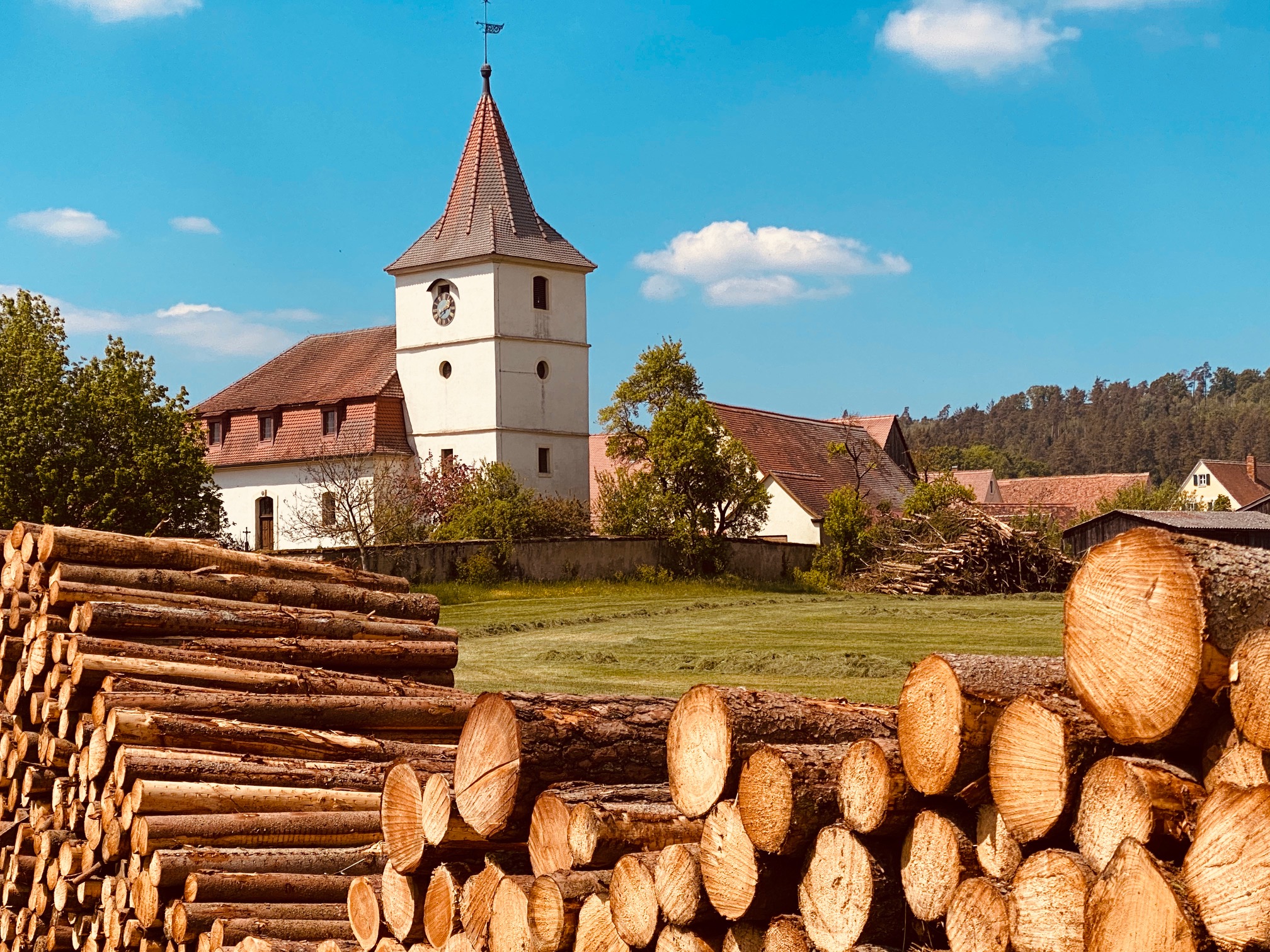
Schwaebisch Hall, Baden-Wuerrtemberg
Schwäbisch Hall , Germany was photographed by James Derheim, European Focus Private Tours, ini June, 2018.
Schwäbisch Hall ‘Swabian Hall’; from 1802 until 1934 and colloquially: Hall is a city in the German state of Baden-Württemberg located in the valley of the Kocher river, the longest tributary (together with its headwater Lein) of the Neckar river. The closest larger city is Heilbronn, and Schwäbisch Hall lies north-east of the state capital of Stuttgart. It is the seat of the district (Landkreis) of Schwäbisch Hall.
Unlike its name might suggest, Schwäbisch Hall lies in the region of Heilbronn-Franconia, the East Franconian-speaking northeasternmost part of Baden-Württemberg, which is culturally and linguistically more closely related to the adjoining region of Franconia in neighbouring Bavaria than to the Alemannic-speaking regions of Württemberg, Baden, Switzerland, Bavarian Swabia, Vorarlberg, Alsace and Liechtenstein.
The city’s main landmarks are the market square with St Michael’s Church (St. Michaelskirche), Comburg Castle (a former Benedictine monastery) with St Nicholas’ Church (St. Nikolaus und St. Maria), and the Hallian-Franconian Museum (Hällisch-Fränkisches Museum), dedicated to the art and history of Schwäbisch Hall and surrounding Heilbronn-Franconia.
Schwäbisch Hall was a Free Imperial City within the Holy Roman Empire for five centuries until it was annexed by Württemberg in 1802.
Salt was produced from brine by the Celts at the site of Schwäbisch Hall as early as the fifth century BCE. The town was first mentioned in a document called Öhringer Stiftungsbrief dating from 1063. The village probably belonged first to the Counts of Comburg-Rothenburg and went from them to the Imperial house of Hohenstaufen (ca 1116). It was probably Emperor Frederick I who founded the imperial mint and started the coining of the so-called Heller. Hall flourished through the production of salt and coins. Since 1204 it has been called a town.
After the fall of the house of Hohenstaufen, Hall defended itself successfully against the claims of a noble family in the neighbourhood (the Schenken von Limpurg). The conflict was finally settled in 1280 by Rudolph I of Habsburg; this allowed the undisturbed development into a Free Imperial City (Reichsstadt) of the Holy Roman Empire. Emperor Louis IV the Bavarian granted a constitution that settled internal conflicts (Erste Zwietracht) in 1340. After this, the city was governed by the inner council (Innerer Rat) which was composed of twelve noblemen, six “middle burghers” and eight craftsmen. The head of the council was the Stättmeister (mayor). A second phase of internal conflicts 1510–12 (Zweite Zwietracht) brought the dominating role of the nobility to an end. The confrontation with the noble families was started by Stättmeister Hermann Büschler, whose daughter Anna Büschler is the subject of a popular book by professor Steven Ozment (“The Bürgermeister’s Daughter: Scandal in a sixteenth-century German city”). The leading role was taken over by a group of families who turned into a new ruling class. Amongst them where the Bonhöffers, the ancestors of Dietrich Bonhoeffer.
Middle Ages
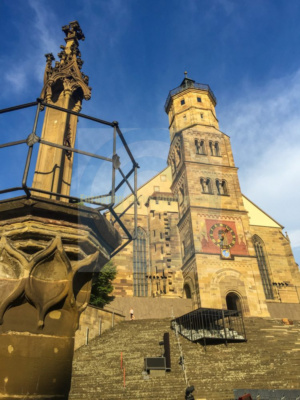
From the 14th to the 16th centuries, Hall systematically acquired a large territory in the surrounding area, mostly from noble families and the Comburg monastery. The wealth of this era can still be seen in some gothic buildings like St. Michael’s Church (rebuilt 1427–1526) with its impressive stairway (1507). The city joined the Protestant Reformation very early. Johannes Brenz, a follower of Martin Luther, was made pastor of St. Michael’s Church in 1522 and quickly began to reform the church and the school system along Lutheran lines.
Hall suffered severely during the Thirty Years’ War, though it was never besieged or scene of a battle. However, it was forced to pay enormous sums to the armies of the various parties, especially to the imperial, Swedish and French troops, who also committed numerous atrocities and plundered the city and the surrounding area. Between 1634 and 1638 every fifth inhabitant died of hunger and disease, especially from the bubonic plague. The war left the city an impoverished and economically ruined place. But with the help of reorganizations of salt production and trade and a growing wine trade, there was an astonishingly fast recovery.
17th century to early 20th century
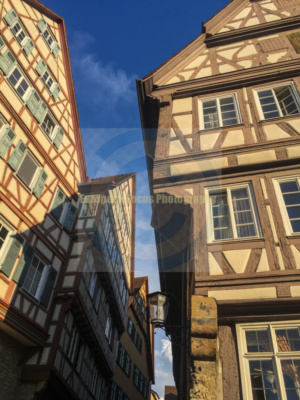
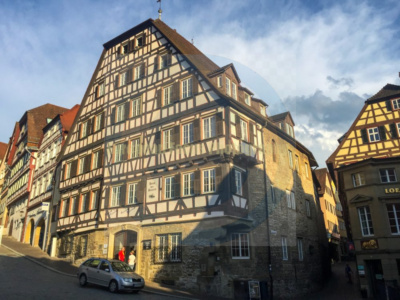
Fires were a constant threat to the mostly wooden houses. The great fires of 1680 and especially of 1728 destroyed much of the city, which led to new buildings in the Baroque style, such as the city hall.

The Napoleonic Wars brought the history of Hall as a Free Imperial City to an end. Following the Treaty of Lunéville (1801), the duke of Württemberg was allowed by Napoleon to occupy the city and several other minor states as a compensation for territories on the Left Bank of the Rhine that fell to France. This took place in 1802 — Hall lost its territory and its political independence and became a Oberamtsstadt (seat of an Oberamt, comparable to a county). Ownership of the salt works was handed over to the state. A long economic crisis during the 19th century forced many citizens to move to other places in Germany or to emigrate overseas, mostly to the United States. While other towns like Heilbronn grew steadily due to the Industrial Revolution, the population of Hall stagnated. The economic situation improved during the second half of the 19th century — a main factor was the railway line to Heilbronn (1862) — but was not followed by a significant growth of the city. It was not until the 1920s and 1930s that new settlements were built on the heights surrounding the old town. Hall also grew through the incorporation of Steinbach (1930) and Hessental (1936).
In 1827, a health spa was established on one of the islands in the Kocher river. Especially after the building of the railway (1862) it became a considerable economical factor. The well-preserved old town also brought a rising number of tourists. Since the beginning of the 20th century, Hall has developed many festivities. Especially well known are the theatre productions which are performed every year in the centre of the city on the steps of St. Michael.
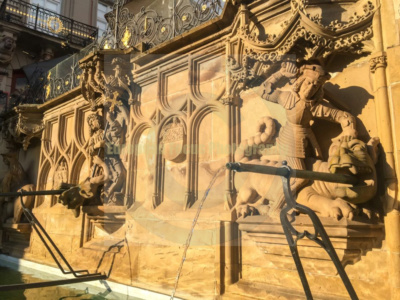
In this gallery, a photo of the famous Fish Fountain on the Marktplatz: The Fish Fountain is a preserved peculiarity, namely a box fountain. It was built by the church master builder Konrad Schaller, while the three high reliefs were created by Riemenschneider’s employee Hans Beuscher. They depict St. Michael fighting a monster three times: a dragon, a lindworm, and a lion. When the fountain was erected in 1509 on the market square (fish was once sold here, hence the fountain’s name), the pillory that had previously stood on the churchyard wall was moved there. Offenders had to stand on the pedestal attached to the fountain and were exposed to the ridicule of the population. The old piece thus served a dual function, something we probably won’t see again soon.
(Wikipedia)