Rostock, Mecklenburg-Vorpommern
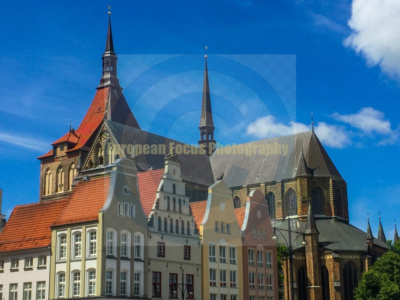
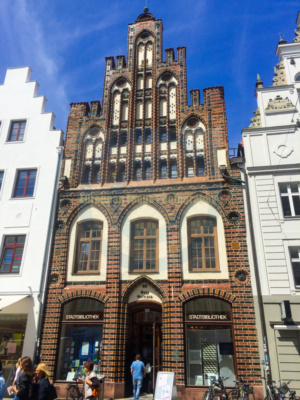
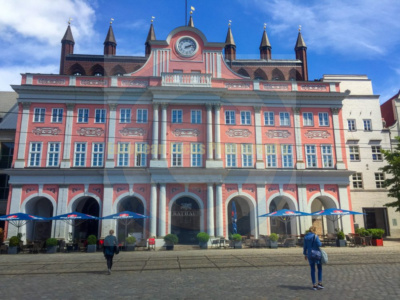
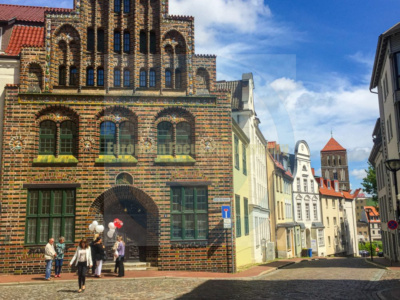
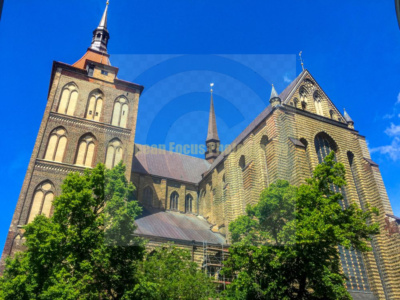
Rostock was photographed by James Derheim, European Focus Private Tours, in June of 2017. Rostock was the first project completed for a genealogist in the winter of 1989. Those images will be added later.
Rostock (/ˈrɒstɒk/;[2] German: [ˈʁɔstɔk] ⓘ), officially the Hanseatic and University City of Rostock (German: Hanse- und Universitätsstadt Rostock), is the largest city in the German state of Mecklenburg-Western Pomerania and lies in the Mecklenburgian part of the state, close to the border with Pomerania.[a] With around 210,000 inhabitants, it is the third-largest city on the German Baltic coast after Kiel and Lübeck, the eighth-largest city in the area of former East Germany, as well as the 39th-largest city of Germany. Rostock was the largest coastal and most important port city in East Germany.
Rostock stands on the estuary of the River Warnow into the Bay of Mecklenburg of the Baltic Sea. The city stretches for about 16 km (10 mi) along the river. The river flows into the sea in the very north of the city, between the boroughs of Warnemünde and Hohe Düne. The city center lies further upstream, in the very south of the city. Most of Rostock’s inhabitants live on the western side of the Warnow; the area east of the river is dominated by the port, industrial estates, and the forested Rostock Heath. The city’s coastline east and west of the river mouth is relatively undeveloped, with long sandy beaches prevailing. The name of the city is of Slavic origin.
Rostock is the economic center of Mecklenburg-Western Pomerania and the state’s only regiopolis (a city outside the core of a metropolitan area). The port of Rostock is the fourth largest port in Germany after the North Sea ports of Hamburg, Bremen/Bremerhaven, and Wilhelmshaven, and the largest port on the German Baltic coast. The ferry routes between Rostock to Gedser in Denmark and to Trelleborg in Southern Sweden are among the busiest between Germany and Scandinavia. Rostock–Laage Airport lies in a rural region southeast of the city.
The city is home to the oldest university in the Baltic region and one of the oldest universities in the world, the University of Rostock, founded in 1419. The university’s hospital, Universitätsmedizin Rostock, is one of two university hospitals in the state, along with Universitätsmedizin Greifswald of the University of Greifswald in Western Pomerania.
Early history
In the 11th century Polabian Slavs founded a settlement at the Warnow river called Roztoc (*ras-tokŭ, Slavic for “fork of a river”); the name Rostock is derived from that designation.
The Danish king Valdemar I set the town on fire in 1161. Afterwards the place was settled by German traders. Initially there were three separate cities:
- Altstadt (Old Town) around the Alter Markt (Old Market), which had St. Petri (St. Peter’s Church),
- Mittelstadt (Middle Town) around the Neuer Markt (New Market), with St. Marien (St. Mary’s Church) and

- Neustadt (New Town) around the Hopfenmarkt (Hop Market, now University Square), with St. Jakobi (St. James’s Church, demolished after World War II).
In 1218, Rostock was granted Lübeck law city rights by Heinrich Borwin, prince of Mecklenburg.
Hanseatic League

During the first partition of Mecklenburg following the death of Henry Borwin II of Mecklenburg in 1226, Rostock became the seat of the Lordship of Rostock, which survived for almost a century. In 1251, the city became a member of the Hanseatic League. In the 14th century it was a powerful seaport town with 12,000 inhabitants and the largest city in Mecklenburg. Ships for cruising the Baltic Sea were constructed in Rostock. The formerly independent fishing village of Warnemünde at the Baltic Sea became a part of Rostock in 1323, to secure the city’s access to the sea.
In 1419, the University of Rostock was founded, the oldest university in continental northern Europe and the Baltic Sea area.
15th to 18th centuries

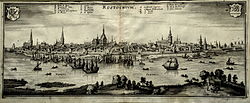
At the end of the 15th century, the dukes of Mecklenburg succeeded in enforcing their rule over the town of Rostock, which had until then been only nominally subject to their rule and essentially independent. They took advantage of a riot known as Domfehde, a failed uprising of the impoverished population. Subsequent quarrels with the dukes and persistent plundering led ultimately to a loss of the city’s economic and political power.

In 1565 there were further clashes with Schwerin that had far-reaching consequences. Among other things, the nobility introduced a beer excise that favoured the dukes. John Albert I advanced on the city with 500 horsemen, after Rostock had refused to take the formal oath of allegiance, and had the city wall razed (slighted) to have a fortress built. The conflict did not end until the first Rostock Inheritance Agreement of 21 September 1573, in which the state princes were guaranteed hereditary rule over the city for centuries and recognizing them as the supreme judicial authority; this bound Rostock for a long time. The citizens razed (or slighted) the fortress the following spring.
From 1575 to 1577 the city walls were rebuilt, as was the Lagebusch tower and the Stein Gate, in the Dutch Renaissance style. The inscription sit intra te concordia et publica felicitas (“Let there be harmony and public happiness within you”), can still be read on the gate, and refers directly to the conflict with the Duke. In 1584 the Second Rostock Inheritance Agreement was enforced, which resulted in a further loss of former city tax privileges. At the same time, these inheritance contracts put paid to Rostock’s ambition of achieving imperial immediacy, as Lübeck had done in 1226.
The strategic location of Rostock provoked the envy of its rivals. Danes and Swedes occupied the city twice, first during the Thirty Years’ War (1618–48) and again from 1700 to 1721. Later in the early 19th century, the French, under Napoleon, occupied the town for about a decade until 1813. In nearby Lübeck-Ratekau, Gebhard Leberecht von Blücher, who was born in Rostock and who was one of few generals to fight on after defeat at the Battle of Jena, surrendered to the French in 1806. This was only after furious street fighting in the Battle of Lübeck, in which he led some of the cavalry charges himself. By the time of the surrender, the exhausted Prussians had neither food nor ammunition.
19th century
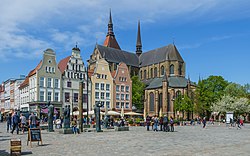
In the first half of the 19th century, Rostock regained much of its economic importance, due at first to the wheat trade, then, from the 1850s, to industry, especially its shipyards. The first propeller-driven steamers in Germany were constructed here.
The city grew in area and population, with new quarters developing in the south and west of the ancient borders of the city. Two notable developments were added to house the increasing population at around 1900:
- Steintor-Vorstadt in the south, stretching from the old city wall to the facilities of the new Lloydbahnhof (Lloyd Railway Station, now Rostock Hauptbahnhof), was designed as a living quarter. It consisted mostly of large single houses, once inhabited by wealthy citizens.
- Kröpeliner-Tor-Vorstadt in the west, was designed to house the working population as well as to provide smaller and larger industrial facilities, such as the Mahn & Ohlerich’s Brewery (now Hanseatische Brauerei Rostock). The main shipyard, Neptun, was nearby at the shore of the river.
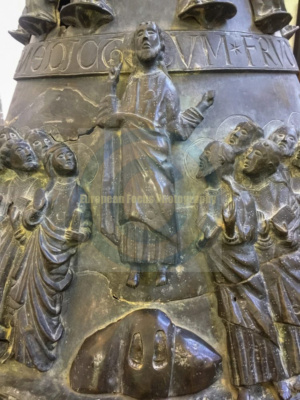
The baptismal font in St. Mary’s Church (Marienkirche) in Rostock, Germany, is a renowned bronze, medieval masterpiece created around 1290. It is a significant, well-preserved artwork from the Hanseatic period, featuring detailed scenes from the life and passion of Jesus. The font is a major historical highlight of the church.
 Marienkirche Rostock +4
- Artistic Design: The font is heavily decorated with scenes, particularly highlighting the life and passion of Jesus.
- Structure: It is an enormous bronze piece, indicating the wealth of the church and city during its construction in the late 13th century.
- Context: It is located within the St. Mary’s Church, which is the main, historic church in Rostock that survived World War II.
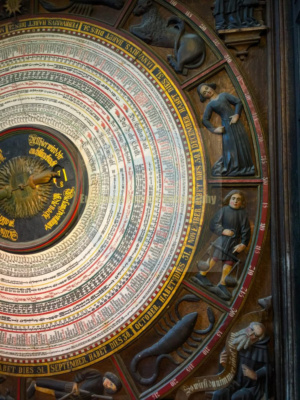
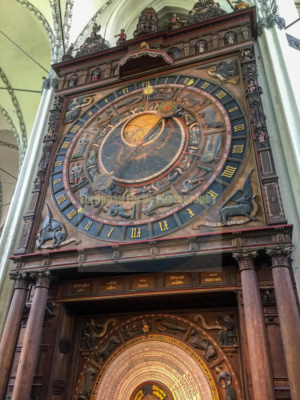
- Significance: It serves as one of the key, early-Gothic, and medieval, treasures in the church, alongside the 15th-century astronomical clock.
Source: Wikipedia