Unsleben, Bavaria
Unsleben, Germany was photographed as part of a genealogy tour with a family historian in April, 2017. If you have interests in other aspects of this village, please fill out my contact form, here: https://europeanancestryphotos.com/contact/
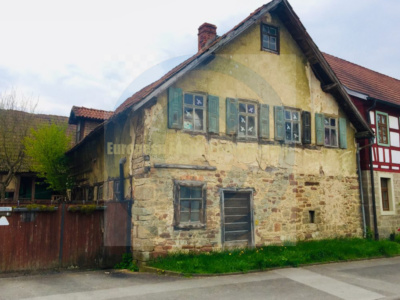
This project was done for a genealogist interested in her Jewish ancestors. Therefore, the project presented here centers around Jewish history. For more:
In the early days of the castle lords von Speßhardt there were only two or three Jewish families in Unsleben. In the course of the 17th century and until the von Habermann family took over the castle in 1749, the number of Jewish families had grown to 26. As in other villages, the nobles were able to increase their income by safeguarding Jews – through protection fees, rental income and many kinds of taxes. Under the von Habermanns, the number of Jewish families increased to nearly 40 from 1749 to 1817. The income from Jews accounted for about 25% of the total castle budget.
With the takeover of the former prince-bishopric by the Bavarians, the Jews also came to benefit from the Bavarian Jewish Edict of 1813, which granted limited civil rights to those who until then had been almost without any rights, and made the protective rule superfluous. From then on, the Jews became visibly more prosperous, which initially brought even more friction with the Christian inhabitants.
Christians and Jews had about the same number of children, seven to eight and more. However, infant mortality among the Jews was much lower than among the Christians, a consequence of the difference in wealth. The proportion of Jewish families therefore grew even further to 60 around the year 1860, when Jews made up more than 25% of Unsleben’s population.
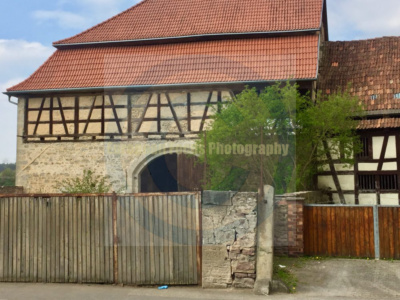
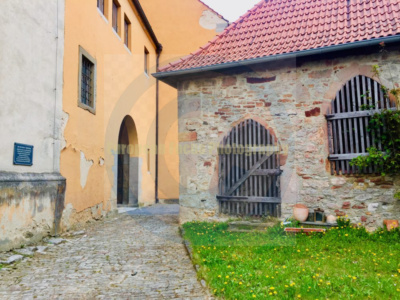
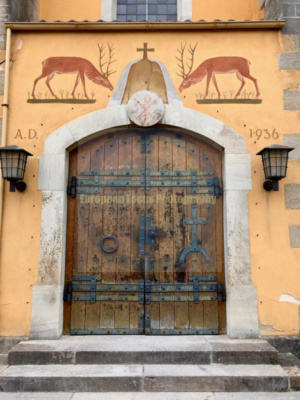
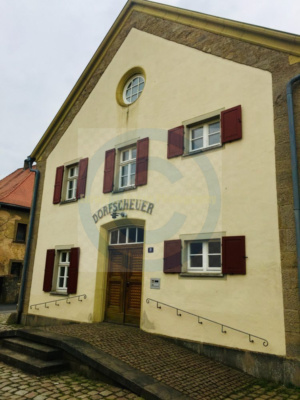
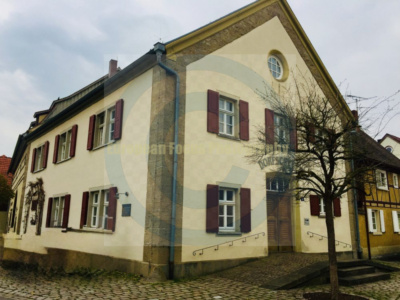
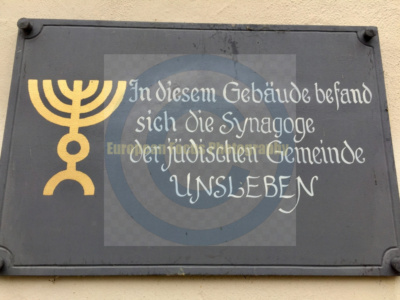
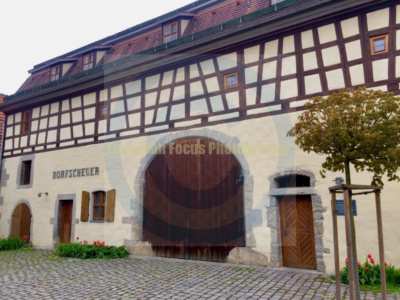
The synagogue was housed in a primitive building in the courtyard of the property Streugasse 17. The Jews therefore bought one of the tithe barns in the Kemmete as early as 1837 and built their synagogue there from scratch in 1856/57 after demolishing the tithe barn.
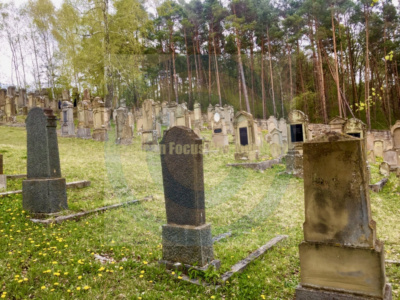
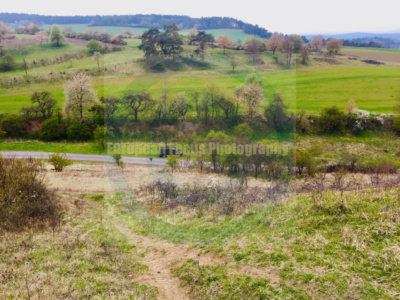
Until then, the Jews, like almost all Jews of today’s Rhön-Grabfeld district, had to bury their dead on the Jewish hill in Kleinbardorf. Each time this meant an arduous undertaking in view of the traffic conditions of that time, especially since at least ten men had to be present at each burial. Therefore, in many places, including Unsleben, the Jews established their own cemeteries around this time. In contrast to the Christian cemeteries, they were as far away from the village as possible for various reasons (cheap land acquisition, out of sight of the Christians, peace of the dead).
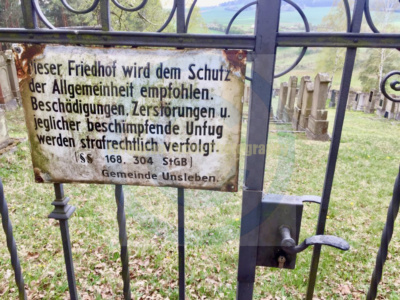
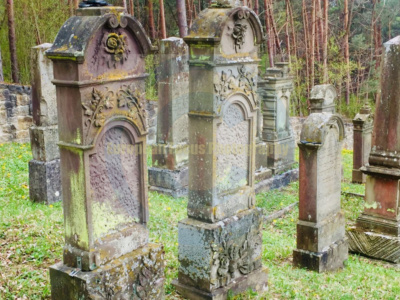
225 Jews were buried ion the Unsleben cemetery from 1857 to 1940; almost all the graves are preserved to this day. Unfortunately, a certain number of the graves are anonymous, because vandalism during the Nazi period destroyed some of the grave markers, and by far not all of them were replaced in the post-war period.
In the second half of the 19th century, the Jews also began to migrate from the villages to the cities, but also to America, because there were better development opportunities for the predominantly business-oriented Jews.
With the founding of the first German Reich in 1871, theJews finally received full rights as citizens. Only judgeship and career as an officer remained blocked to them. They also began to integrate more and more into the village community while retaining their religion. They became members of the local associations, also in the board of directors as secretary or treasurer. In a village like Unsleben, they avoided intermarriage with Christians and were very orthodox in their beliefs. This also prevented complete assimilation in the village community.
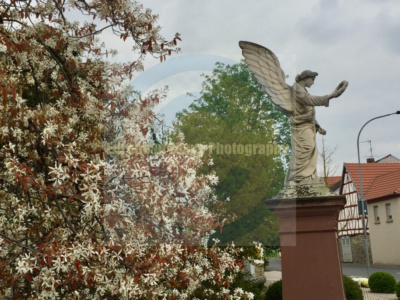
In 1932, there were still 31 Jewish houses and 47 households in Unsleben. By 1939, most of them were able to emigrate. However, single older Jews were placed in old people’s homes in Würzburg at the beginning of the 1940s; they were deported to Theresienstadt in September 1942 and killed there. The families and sprightly elderly who remained in Unsleben were deported to Izbica via Würzburg in April 1942 and perished there. The municipality has erected a memorial to the victims of the Holocaust in Schlossgasse near their synagogue – against the oblivion.
(Text: Prof. Josef Hesselbach) Link: https://www.unsleben.de/unsere-gemeinde/juedische-gemeinde
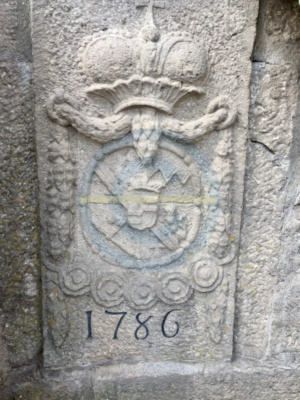
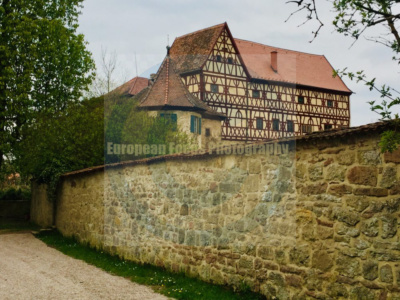
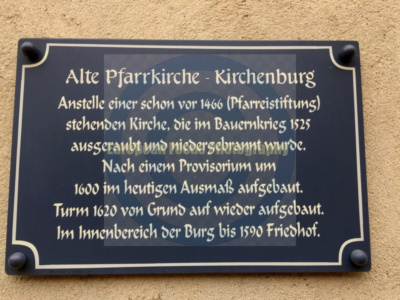
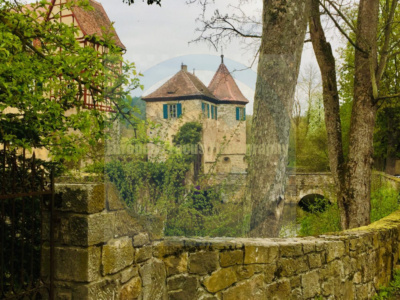
About the castle: Around 1160, Helwicus de Usleybe appears in documents as a ministerialis (a type of unfree knight) of the Bishopric of Würzburg. With the extinction of this family, probably in the mid-14th century, Unsleben passed by inheritance to the Truchsess family of Wetzhausen. In 1525, during the Peasants’ War, the notorious Bilderhausen peasant army burned the castle down. Through marriage, Unsleben passed in 1571 to Wilhelm von Spesshardt, bailiff of Meiningen and Massfeld. In 1727, the Barons von Spesshardt were forced to sell Unsleben to Baron von Gebsattel, who in turn sold it in 1741 to Cornelius Baron von Habermann, Chancellor of the Court of Würzburg, Imperial Councilor, and Count Palatine of the Court. Through marriage, Unsleben passed in 1960 to Maximilian Count zu Waldburg-Wolfegg, whose family has repeatedly and extensively renovated the historic buildings and still owns the castle today. In 1996, the castle and its owners received the Hypo Cultural Foundation’s Heritage Prize. The moated castle is not open to the public due to its private residential use. However, rooms are available for rent as holiday apartments, and the outer bailey houses a restaurant.
Text: Joachim Zeune