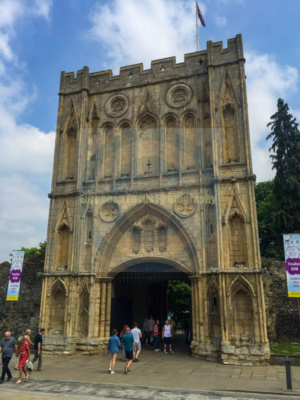
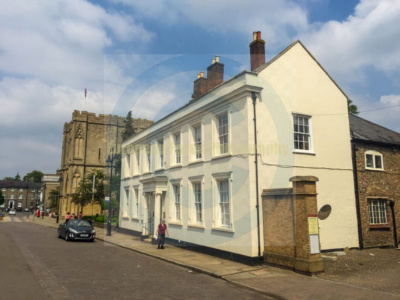
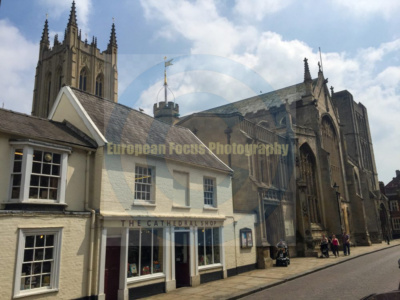
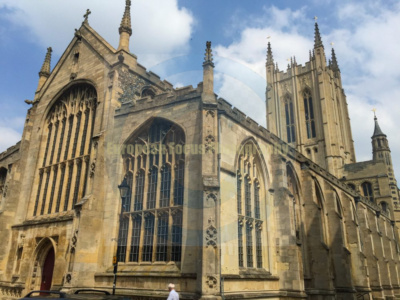
Bury St. Edmunds, Suffolk
Bury St. Edmunds, Suffolk, England was photographed by James Derheim in May, 2018
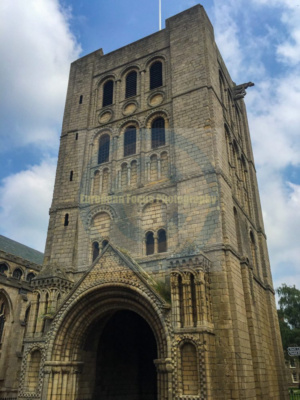
Bury St Edmunds commonly referred to locally as Bury, is a cathedral as well as market town and civil parish in the West Suffolk district, in the county of Suffolk, England The town is best known for Bury St Edmunds Abbey and St Edmundsbury Cathedral. Bury is the seat of the Diocese of St Edmundsbury and Ipswich of the Church of England, with the episcopal see at St Edmundsbury Cathedral. The town, originally called Beodericsworth, was built on a grid pattern by Abbot Baldwin around 1080. It is known for brewing and malting (Greene King brewery) and for a British Sugar processing factory, where Silver Spoon sugar is produced. The town is the cultural and retail centre for West Suffolk and tourism is a major part of the economy. The built up area had a population of 41,280 at the 2021 census.
Etymology
The name Bury is etymologically connected with borough, which has cognates in other Germanic languages such as German Burg ‘fortress, castle’ and Old Norse borg ‘wall, castle’; and Gothic baurg ‘city’. They all derive from Proto-Germanic *burgs ‘fortress’. This in turn derives from the Proto-Indo-European root *bhrgh ‘fortified elevation’, with cognates including Welsh bera ‘stack’ and Sanskrit bhrant– ‘high, elevated building’. In Medieval Latin it was known as Burgum Sancti Edmundi (also spelled Aedmundi).[10][11] In the Anglo-Saxon period the town was called Bedricesweord or Bedericesworth.
The second section of the name refers to Edmund, King of the East Angles, called Edmund the Martyr, who was killed by the Vikings in the year 869. He became venerated as a saint and a martyr, and his shrine made Bury St Edmunds an important place of pilgrimage.
The formal name of the diocese is “St Edmundsbury”, and the town is colloquially known as Bury.
History

An archaeological study in the 2010s on the outskirts of Bury St Edmunds uncovered evidence of Bronze Age activity in the area. The dig also uncovered Roman coins from the first and second centuries. Samuel Lewis, writing in 1848, notes the earlier discovery of Roman antiquities, and as with several other writers connects Bury St Edmunds with Villa Faustini or Villa Faustina, although the location of this Roman site is also discussed by E. Gillingwater (1804), who notes the lack of evidence for it being here.
The town was one of the royal boroughs of the Saxons. Sigebert, king of the East Angles, founded Beodricesworth monastery here about 633, which in 924 became the burial place of King Edmund the Martyr, who was slain by the Danes in 869, and owed most of its early celebrity to the reputed miracles performed at the shrine of the martyr king. The town grew around Bury St Edmunds Abbey, a site of pilgrimage.
In 942 or 945, King Edmund I had granted to the abbot and convent jurisdiction over the whole town, free from all secular services, and Canute in 1020 freed it from episcopal control. Later, Edward the Confessor made the abbot lord of the franchise. The older monastery was destroyed and, the secular priests having been expelled, a new Benedictine abbey was built. Count Alan Rufus is said to have been interred at Bury St Edmunds Abbey in 1093. In the 12th and 13th centuries the head of the de Hastings family, who held the Lordship of the Manor of Ashill in Norfolk, was hereditary Steward of this abbey.

The town was for a time the home of a thriving Jewish community, and it is likely, although not certain, that Moyse’s Hall belonged to a Jewish merchant. On 18 March 1190, two days after the more well-known massacre of Jews at Clifford Tower in York, the people of Bury St Edmunds massacred 57 Jews. Later that year, Abbot Samson successfully petitioned King Richard I for permission to evict the town’s remaining Jewish inhabitants “on the grounds that everything in the town… belonged by right to St Edmund: therefore, either the Jews should be St Edmund’s men or they should be banished from the town.” This expulsion predates the Edict of Expulsion by 100 years. In 1198, a fire burned the shrine of St Edmund, leading to the inspection of his corpse by Abbot Samson and the translation of St Edmund’s body to a new location in the abbey.
The town is associated with Magna Carta. In 1214 the barons of England are believed to have met in the abbey church and sworn to force King John to accept the Charter of Liberties, the document which influenced the creation of Magna Carta, a copy of which was displayed in the town’s cathedral during the 2014 celebrations. By various grants from the abbots, the town gradually attained the rank of a borough.
Henry III in 1235 granted to the abbot two annual fairs, one in December and the other the great St Matthew’s fair, which was abolished by the Fairs Act of 1871. In 1327, the Great Riot occurred, in which the local populace led an armed revolt against the abbey. The riot destroyed the main gate, and a new, fortified gate was built in its stead. On 11 April 1608 a great fire broke out in Eastgate Street, which resulted in 160 dwellings and 400 outhouses being destroyed.

The town developed into a flourishing cloth-making town, with a large woollen trade, by the 14th century. In 1405 Henry IV granted another fair.
Elizabeth I in 1562 confirmed the charters which former kings had granted to the abbots. The reversion of the fairs and two markets on Wednesday and Saturday were granted by James I in fee farm to the corporation. James I in 1606 granted a charter of incorporation with an annual fair in Easter week and a market. James granted further charters in 1608 and 1614, as did Charles II in 1668 and 1684.
Parliaments were held in the borough in 1272, 1296 and 1446, but the borough was not represented until 1608, when James I conferred on it the privilege of sending two members. The Redistribution of Seats Act 1885 reduced the representation to one.
The borough of Bury St Edmunds and the surrounding area, like much of East Anglia, being part of the Eastern Association, supported Puritan sentiment during the first half of the 17th century. By 1640, several families had departed for the Massachusetts Bay Colony as part of the wave of emigration that occurred during the Great Migration. Bury’s ancient grammar school also educated such notables as the puritan theologian Richard Sibbes, master of St Catherine’s Hall in Cambridge, antiquary and politician Simonds d’Ewes, and John Winthrop the Younger, who became governor of Connecticut.
The town was the setting for witch trials between 1599 and 1694.
Modern history
The population had reached 12,538 by 1841.
A permanent military presence was established in the town with the completion of the Militia Barracks in 1857 and of Gibraltar Barracks in 1878.
During the Second World War, the USAAF used Rougham Airfield outside the town.
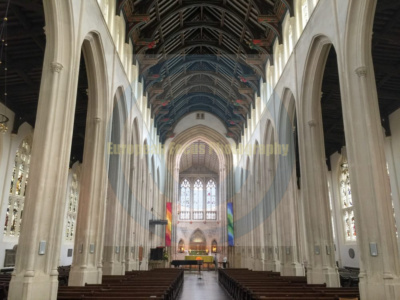
St Mary’s Church is the civic church of Bury St Edmunds in Suffolk, England and is one of the largest parish churches in England. It claims to have the second longest nave (after Christchurch Priory), and the largest West Window of any parish church in the country. It was part of the abbey complex and originally was one of three large churches in the town (the others being St James, now St Edmundsbury Cathedral, and St Margaret’s, now gone).
History
The church’s full name is The Church of the Assumption of the Blessed Virgin Mary.
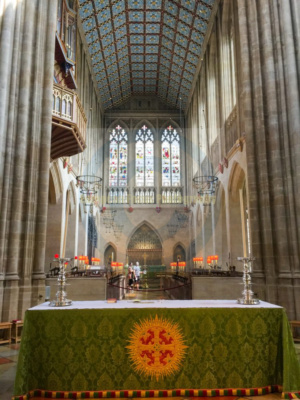
The present church is not the first building to stand on the site, the first being built in the seventh century, founded by King Sigeberht. The second church was built in the early twelfth century by Abbot Anselm to replace the previous church of St Mary which was demolished to make space for the construction of the south wing of the Abbey Church. However, nothing survives of the Norman church and the oldest part of the existing building is the decorated chancel (c. 1290). There was a major renovation between the 14th and 16th centuries and it is at this point that the nave, its aisles and the tower were built. It is also at this time that Mary Tudor, Queen of France, favourite sister of Henry VIII (not to be confused with his daughter Mary I of England), died and was buried in the abbey church. When the abbey was destroyed, her body was removed and reburied here in St Mary’s. Her tomb is in the sanctuary directly to the north of the Lord’s table. The church, however, is dedicated to Mary, the mother of Jesus, and not, as some mistakenly believe, to Mary Tudor. A tablet was erected to her memory in 1758. At the suggestion of Edward VII, who visited the church in 1904, a marble kerb surrounds her grave stone.
During the 16th century, John Notyngham and Jankyn Smyth, two wealthy local benefactors, bequeathed large amounts of money to the church. These funds contributed to building the north and south quire aisles, now the Lady Chapel and Royal Anglian (formerly Suffolk Regimental) chapel, two chantry chapels and a north and south porch. The north porch, known as the Notyngham porch, was built in 1437 in accordance with the will of John Notyngham. The south porch of 1523 was removed during a restoration in 1831. St Wolstan’s chapel, on the north-west side, formerly held the Suffolk Regimental cenotaph until it was moved to the end of the north aisle. It now holds the church kitchen.
The west window is believed to be the largest of any parish church in the country, measuring 35 ft 6in by 8 ft 6in.[6]
The church is awarded three stars by Simon Jenkins in his 1999 book England’s Thousand Best Churches.Jenkins writes:
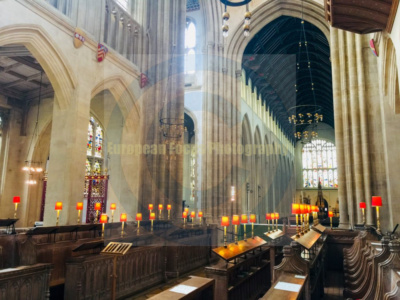
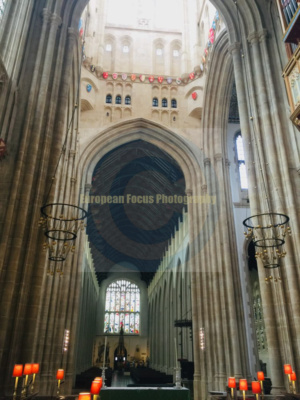
The interior has one of the largest and most exhilarating naves in the country. Arcades of ten majestic bays march towards the chancel, each rising on continuous mouldings with only the tiniest of capitals. The unusually wide hammerbeam roof is a marvellous survival. Eleven pairs of angels guard the space below, attended by lesser angels on the wallplates and by saints, martyrs, prophets and kings, 42 figures in all. On the frieze a medieval menagerie takes over, with dragons, unicorns, birds and fish. … The south chapel is littered with pleasant brasses. The north aisle by the tower has its memorials spectacularly displayed. They climb up the wall to the ceiling, a valhalla of Bury worthies.
Choirs
Until recently, St Mary’s Church had a traditional Anglican choir of boys and gentlemen, with a history dating back to as early as 1354, after which there are many references to singers and ‘childs with a surplys’. This tradition is believed to have remained untouched even during Puritan times. The choir has in the past toured Spain, Turkey, Cyprus, Israel and Malta, France, Belgium, and Germany, and has sung evensongs at cathedrals including Canterbury and St Paul’s. The Choir is affiliated to the RSCM, and choristers are trained using the RSCM Voice for Life scheme.
2010 saw the inception of St Mary’s Ladies’ Choir, and the Girls’ Choir began in 2015. Although they were formerly quite separate from the Church Choir, joining together only for large services, the choir is now mixed.
Organ
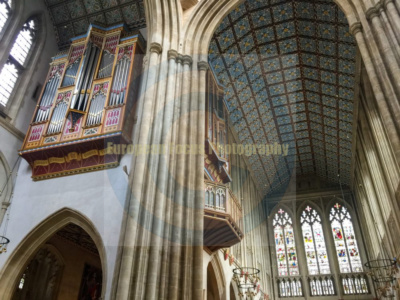
There is evidence for an organ in St Mary’s as early as 1467, in the will of John Baret which states that ‘ye pleyers at ye orgenys [to be paid] ij d’. Another bequest from 1479 grants the organist 10d.
The main organ is a four-manual instrument with 79 speaking stops. Built initially by John Gray of London in 1825, it was rebuilt and enlarged in 1865, 1885, and 1898 by J. W. Walker. There have been later rebuilds by Hill, Norman and Beard in 1931, John Compton in 1959, and Kenneth Canter in 1988, the latter included providing a mobile console. The organ was over-hauled in 2009 by Clevedon Organ Services, and is equipped with a 250-channel memory.
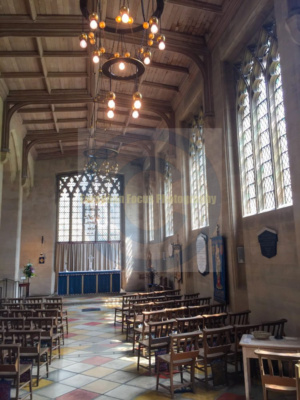
A separate, portable four-stop chamber organ, possibly by John Harris (son of Renatus Harris, c. 1677 – 1743) is placed in the Suffolk Regimental Chapel and is occasionally used as a continuo instrument.
Organists
The following list is taken from Peter Tryon’s book.
- Ralph Guest 1796–1822.
- Robert Nunn 1822–1863
- Thomas Bentick Richardson 1864–1893 (formerly chorister and assistant organist at Salisbury Cathedral)
- Matthew Kingston 1893–1896
- George William Boutell 1897–1909
- Edwin Percy Hallam 1909–1937 (subsequently organist at St Edmundsbury Cathedral)
- Clifton Cecil Day 1937–1942
- Dr Adcock 1942–1948
- Norman Holdford Jones 1948–1969
- John Fear 1969–1980
- David Ivory 1980–1982 (formerly assistant)
- Peter Tryon 1983–2015
- Adrian Marple 2015–2018 (formerly assistant; subsequently Director of Music at Inverness Cathedral)
- DB di Blasio 2018–2020 (formerly assistant)
- Richard Baker 2021–2022
- DB di Blasio 2023–present

Notable burials
- Mary Tudor, Queen of France and sister of Henry VIII, (d. 1533).
- Nicholas Clagett the Elder (d. 1662), English Puritan cleric and ejected minister.
- Sir William Carew (d. 1501)[22] of Bury St Edmunds, created a knight banneret by King Henry VII, after the Battle of Blackheath (1496). He was the fifth son of Nicholas III Carew of Mohuns Ottery in Devon, by his wife Joan Courtenay (born 1411), a daughter of Sir Hugh Courtenay (1358–1425) of Haccombe in Devon and of Boconnoc in Cornwall, MP and Sheriff of Devon, a grandson of Hugh de Courtenay, 2nd/10th Earl of Devon (1303–1377) and grandfather of Edward Courtenay, 1st Earl of Devon (d.1509)
- George Kirbye (d. 1634), madrigalist and churchwarden of St Mary’s.
- Peter Gedge (d. 1818), founder of the Bury and Norwich Post
- John Reeve (d. 1540), last abbot of Bury St Edmunds