Newport Pagnell, Buckinghamshire
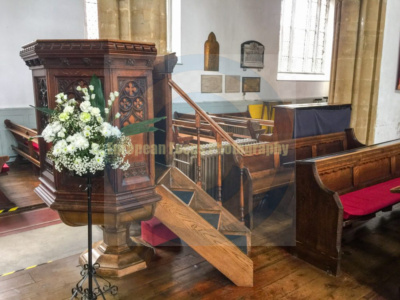
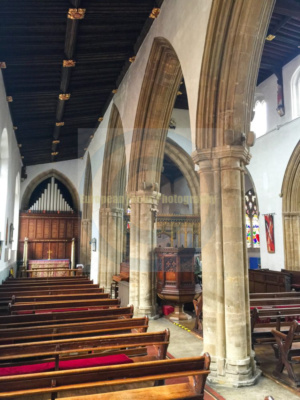
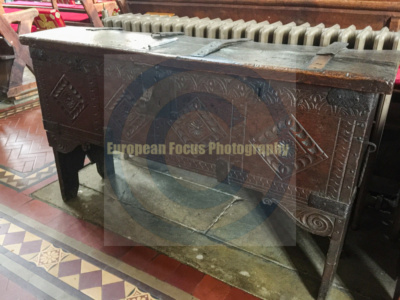
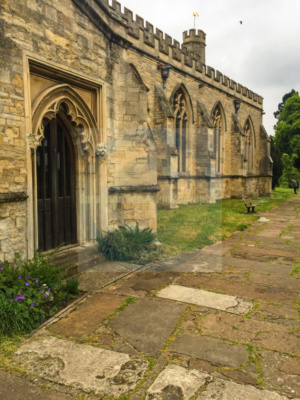
Photographed by James Derheim, European Focus Private Tours, in May, 2018. This gallery does not include a full exterior photograph of the parish church, only interior photos.
Newport Pagnell is a town and civil parish in the City of Milton Keynes, Buckinghamshire, England.[2] The Office for National Statistics records Newport Pagnell as part of the Milton Keynes urban area.[3]
The town is separated from the rest of the urban area by the M1 motorway, on which Newport Pagnell Services, the second service station to be opened in the United Kingdom, is located.
The town is more widely known for having the only remaining vellum manufacturer in the United Kingdom, and being the original home of the exclusive sports car manufacturer Aston Martin.
History

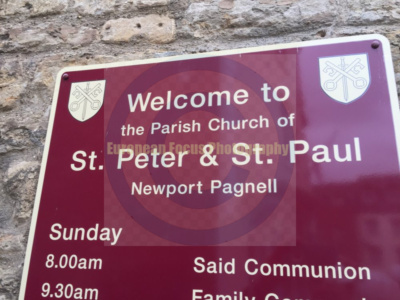
The town was first mentioned in the Domesday Book of 1086 as Neuport, Old English for ‘New Market Town’, but by that time, the old Anglo-Saxon town was dominated by the Norman invaders. The suffix ‘Pagnell’ came later when the manor passed into the hands of the Pagnell (Paynel) family.[4][5] It was the principal town of the “Three Hundreds of Newport”,[6] the north Buckinghamshire district that had almost the same boundary as the modern City of Milton Keynes unitary authority area. The Grade I listed parish Church of St Peter and St Paul, Newport Pagnell is first recorded in the mid 1100s.
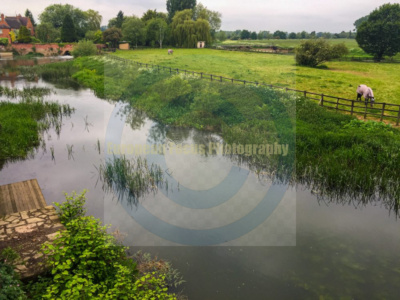
The Grade I listed Tickford Bridge, over the River Ouzel (or Lovat), was built in 1810.[7] It is one of just a few cast iron bridges in Britain that still carry modern road traffic.[7] Near the footbridge at the side, there is a plaque placed by Newport Pagnell Historical Society that gives details of its history and construction. The Ouzel joins the Great Ouse nearby, and a large set of sluice gates – used to control downstream flooding – is located near the bridge.
Between 1817 and 1864, the town was linked to the Grand Junction Canal at Great Linford via the Newport Pagnell Canal.[8] In 1862, the canal owners sold the route to the London and North Western Railway.[9] For a hundred years (1867 to 1967), Newport Pagnell was served by Newport Pagnell railway station, the terminus on the Wolverton to Newport Pagnell branch line. (The route is now a rail trail, part of the Milton Keynes redway system.)
The population of Newport Pagnell and its hinterland at the 1801 Census was 17,576; by 1911 it had grown to 14,428.[10] The population of Newport Pagnell Urban District alone is first recorded at the 1911 Census as 4,238 and had reached 4,743 by 1961.[11]
Listed buildings and structures

The town has one scheduled monument (Civil War defences in Bury Field[12]), two buildings or structures listed at Grade I (Tickford Bridge[7] and the parish church of SS Peter and Paul[13]), one at Grade II* (84 High St.[14]) and a further 118 at Grade II.[15]
The Old Town Hall Chambers, now apartments, were built as a school in the early 19th century.[16]
The St Peter and St Paul is a Grade I listed parish church in Newport Pagnell, Buckinghamshire, England.[1] The building is mainly medieval with many subsequent changes. The church was Grade I listed on 24 October 1950.[1]
History

Sometime in the mid-1100s, Fulk Paynel (the Norman lord of the town) granted the church (then called the Church of Saint Mary) to the priory of Tickford.[3][4] “The prior undertook to provide a dwelling-house for the vicar and a deacon to assist him, besides maintaining him at the table of the priory, paying him a yearly stipend of 20 shillings and allowing him a certain proportion of the offerings of parishioners”.[2][a]
Architecture
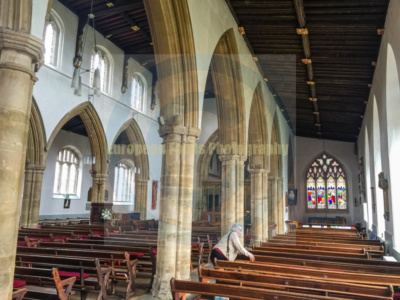
The church is mainly medieval (14th Century) with a mid 16th century ashlar faced west tower; it was restored in the early 19th century, when battlements and pinnacles were added to the tower.[1] The south doorway and porch date from c. 1355.[1]
The chancel measures internally 37 ft 0 in × 18 ft 6 in (11.28 m × 5.64 m) and the north vestries, organ chamber and nave is 94 ft × 25 ft (28.7 m × 7.6 m).[2] “The east wall of the nave, which is 5 ft 4 in (1.63 m) thick, probably incorporates the remains of the central tower of an early cruciform church, but all other parts of the structure were entirely rebuilt in the middle of the 14th century”.[2]
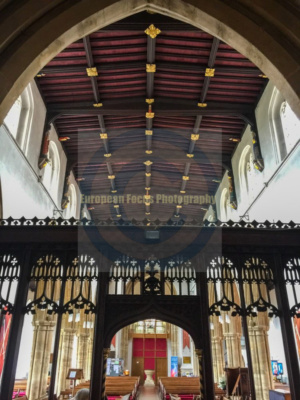
The nave has a richly moulded low-pitched roof of the early 16th century, with foliated bosses at the intersections of the timbers. The wall-posts are connected to the beams by curved brackets and are supported by stone corbels carved as angels holding shields, while in front of each of the posts is a carved wood figure, two of the figures representing angels and the others saints, including the twelve apostles. There are also carved figures of angels at the centres of the tie-beams and at the feet of the intermediate rafters. The lean-to roofs of the aisles are of the same character and period, and have carved wooden figures at the lower corners. Tie-beams and wallplates of the Tudor period have also been re-used with the modern timbers of the chancel roof.[2]
— Victoria History of the Counties of England: a history of the County of Buckingham (1927)
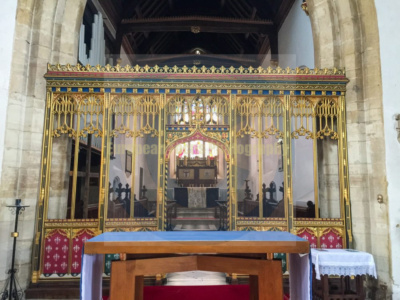
The rood screen (or chancel screen) dates from 1875.[5]
The church today
The Benefice of Newport Pagnell with Lathbury and Moulsoe is a group of four Church of England churches.