Orvieto, Umbria
Orvieto, Umbria, Italy was photographed by James Derheim, European Focus Private Tours, in various years beginning with 2014
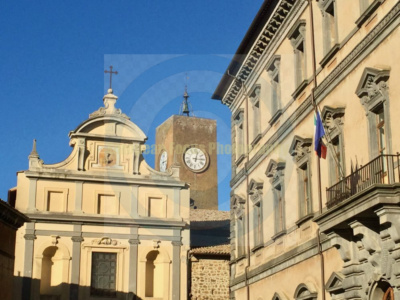
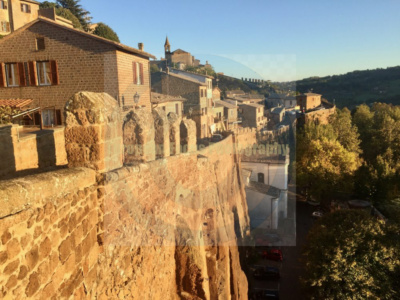
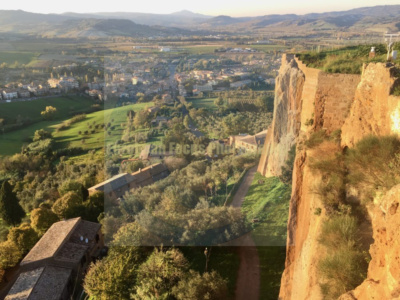
Orvieto is a city and comune in the Province of Terni, southwestern Umbria, Italy, situated on the flat summit of a large butte of volcanic tuff. The city rises dramatically above the almost-vertical faces of tuff cliffs that are completed by defensive walls built of the same stone.
The ancient city (urbs vetus in Latin, whence “Orvieto”), populated since Etruscan times, has usually been associated with Etruscan Velzna, but some modern scholars differ. Orvieto was certainly a major centre of Etruscan civilization; the archaeological museum (Museo Claudio Faina e Museo Civico) houses some of the Etruscan artifacts that have been recovered in the immediate area. A tomb in the Orvieto Cannicella necropolis bears the inscription mi aviles katacinas, “I am of Avile Katacina”; the tomb’s occupant thus bore an Etruscan-Latin first name, Aulus, and a family name that is believed to be of Celtic origin (derived from “Catacos”). This interesting artifact might show the complexity of ethnic relations in ancient Italy, and how such relations could be peaceful.
Also in the area is the Golini Tomb, which was constructed in the fourth century BC. Its wall paintings depict a funeral banquet, giving some insight into the real-life gatherings held after the deaths of aristocratic Etruscans. The pictures include scenes of servants preparing for the feast in various ways.[5]
Roman and post-Roman antiquity
Orvieto was annexed by Rome in the third century BC. Because of its site on a high, steep bluff of tuff, a volcanic rock, the city was virtually impregnable. After the collapse of the Roman Empire its defensible site gained new importance: the episcopal seat was transferred from Bolsena, and the city was held by Goths and by Lombards before its self-governing commune was established in the tenth century, in which consuls governed under a feudal oath of fealty to the bishop. Orvieto’s relationship to the papacy has been a close one; in the tenth century Pope Benedict VII visited the city of Orvieto with his nephew, Filippo Alberici, who later settled there and became Consul of the city-state in 1016. By the thirteenth century, three papal palaces had been built.
Middle Ages


Orvieto, sitting on its impregnable rock controlling the road between Florence and Rome where it crossed the Chiana, was a large town: its population numbered about 30,000 at the end of the 13th century.[6] Its municipal institutions already recognized in a papal bull of 1157,[7] from 1201 Orvieto governed itself through a podestà, who was as often as not the bishop, however, acting in concert with a military governor, the “captain of the people”. The city was divided into four rione or districts: Serancia, San Giovenale, Postierla, and Santa pace. In the 13th century bitter feuds divided the city, which was at the apogée of its wealth but found itself often at odds with the papacy, even under interdict. Pope Urban IV stayed at Orvieto from 1262 to 1264.
The city became one of the major cultural centers of its time when Thomas Aquinas taught at the studium there. A small university (now part of the University of Perugia), had its origins in a studium generale that was granted to the city by Pope Gregory IX in 1236. After teaching in Orvieto, Aquinas was called to Rome in 1265 to serve as papal theologian to the newly elected Pope Clement IV, and as Regent master of the Santa Sabina studium provinciale, the forerunner of the Pontifical University of Saint Thomas Aquinas, Angelicum.
Papal rule
The territory of Orvieto was under papal control long before it was officially added to the Papal States (various dates are quoted). It remained a papal possession until 1860, when it was annexed to a unified Italy.
The Cathedral
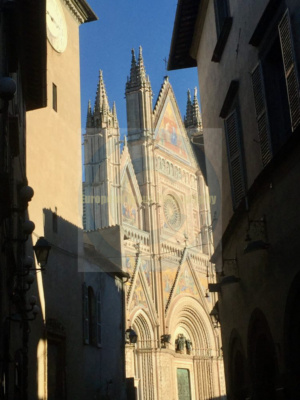
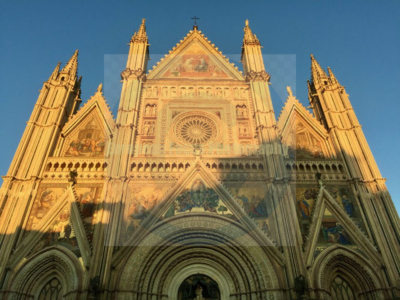
On 15 November 1290, Pope Nicholas IV laid the cornerstone for the present building and dedicated it to the Assumption of the Virgin, a feast for which the city had a long history of special devotion. The design has often been attributed to Arnolfo di Cambio, but the prevailing modern opinion is that the master mason was an obscure monk named Fra’ Bevignate from Perugia. The church is striped in white travertine and greenish-black basalt in narrow bands, similar in many ways to the cathedral of Siena and other central Italian cathedrals of that era. In the following decade, cathedral authorities called Sienese architect and sculptor Lorenzo Maitani to stabilize the building and design a façade. He enlarged the choir and planned a transept with two chapels (c. 1308–1330), spaces that were not finished until long after his death. The cathedral has five bells, tuned in E flat, which date back to the renaissance.
The façade (illustration above) is particularly striking and includes some remarkable sculpture by Lorenzo Maitani (14th century). Inside the cathedral, the Chapel of San Brizio is frescoed by Fra Angelico and with Luca Signorelli’s masterpiece, his Last Judgment (1449–1451). The Corporal of Bolsena, on view in the Duomo, dates from a eucharistic miracle in Bolsena in 1263, when a consecrated host began to bleed onto a corporal, the small cloth upon which the host and chalice rest during the canon of the Mass. (Wikipedia)